Fate, Transportation & Toxicological Effects of PFAS
Per- and Polyfluoroalkyl Substances · Environmental Chemistry & Human Health
Per- and polyfluoroalkyl substances (PFAS) are a family of over 12,000 synthetic chemicals engineered for their exceptional resistance to heat, water, and chemical breakdown. That same stability — rooted in one of the strongest bonds in organic chemistry, the carbon-fluorine bond — makes them virtually indestructible in the environment, earning their designation as "forever chemicals." Decades of industrial use in non-stick coatings, water-repellent textiles, food packaging, and aqueous film-forming foams (AFFF) have resulted in pervasive global contamination of surface water, groundwater, soils, and the atmosphere.
The consequences for human health are significant. PFAS have been detected in human blood serum, breast milk, and umbilical cord blood at concentrations associated with thyroid hormone disruption, immune suppression, altered lipid metabolism, adverse developmental outcomes, and elevated risks of kidney and testicular cancers. The U.S. EPA's recent designation of PFOA and PFOS as hazardous substances under CERCLA reflects the growing urgency of this public health crisis. Yet critical knowledge gaps remain: we still poorly understand how PFAS interact with suspended mineral particles in open water bodies, what transformation products form under environmentally relevant conditions, and whether those products carry greater toxicological risk than the parent compounds.
12,000+
PFAS compounds identified globally
97%
of Americans with detectable PFAS in blood
4 ppt
EPA maximum contaminant level for PFOA & PFOS (2024)
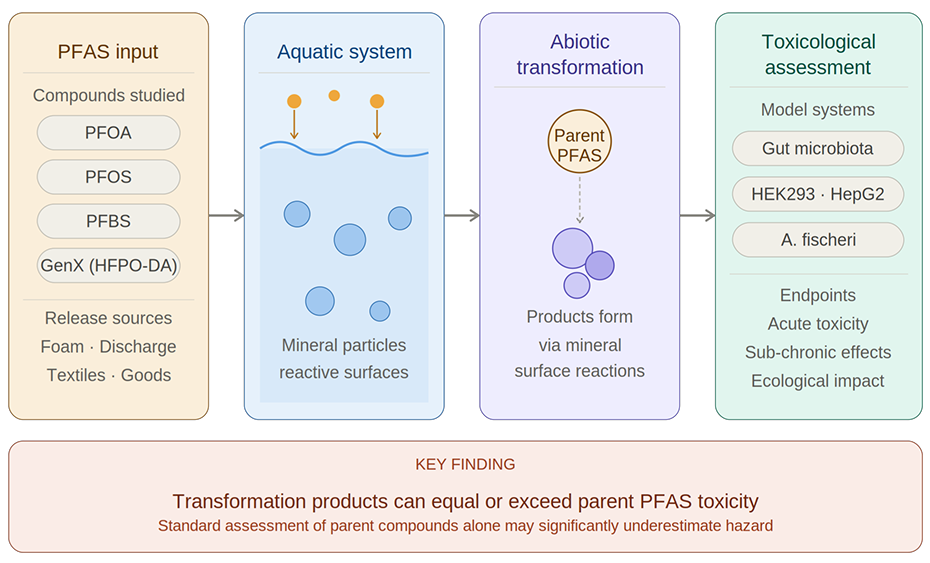
Our overall goal is to determine the environmental fate and abiotic transformation of PFAS in aquatic systems, and to evaluate the long-term health risks of both parent compounds and their transformation products to humans and the broader ecosystem. We investigate how PFOA, PFOS, PFBS, and next-generation replacement compounds such as GenX (HFPO-DA) interact with suspended mineral particles — reactive surfaces that drive diverse and poorly characterized chemistry. These studies are followed by systematic toxicological evaluation across multiple biological model systems to assess real-world health implications.
Abiotic transformation
Quantifying PFAS–mineral particle reactions and identifying transformation products under environmentally relevant aquatic conditions
Toxicological assessment
Evaluating acute and sub-chronic effects of both parent PFAS and transformation products across human and environmental model systems
Risk framework
Developing a transformation product–inclusive risk assessment approach that goes beyond conventional parent compound monitoring
ADMINISTRATIVE ASSISTANT
GAYAN R. RUBASINGHEGE
Associate Professor of Chemistry
New Mexico Institute of Mining and Technology
Department of Chemistry
801 Leroy Place
Socorro, NM 87801
Bethany Jessen
New Mexico Institute of Mining and Technology
Department of Chemistry
801 Leroy Place
Socorro, NM 87801
Phone: 575-835-5129
Fax: 575-835-5215
Phone: 575-835-5263
Fax: 575-835-5364
Copyright © 2018 The Environmental Chemistry Research Research Group. All rights reserved.